Which stabilization approach is best suited to your vessel and operating needs? DSA Ocean helps vessel owners, naval architects, shipyards and equipment suppliers evaluate fin stabilizers, slosh tanks and U-tube anti-roll tanks, including combinations with existing features such as bilge keels.
Our independent engineering analysis compares the vessel’s predicted motions with and without the proposed changes under the same sea and operating conditions. The results show the expected benefits and limitations, helping your team decide how to proceed before committing to construction or a refit.
For example, we can assess whether a proposed anti-roll tank size is likely to provide the required roll reduction, how much benefit fin stabilizers could add alongside existing bilge keels, or whether a different configuration would better suit your operating needs.
Numerical studies using validated seakeeping software
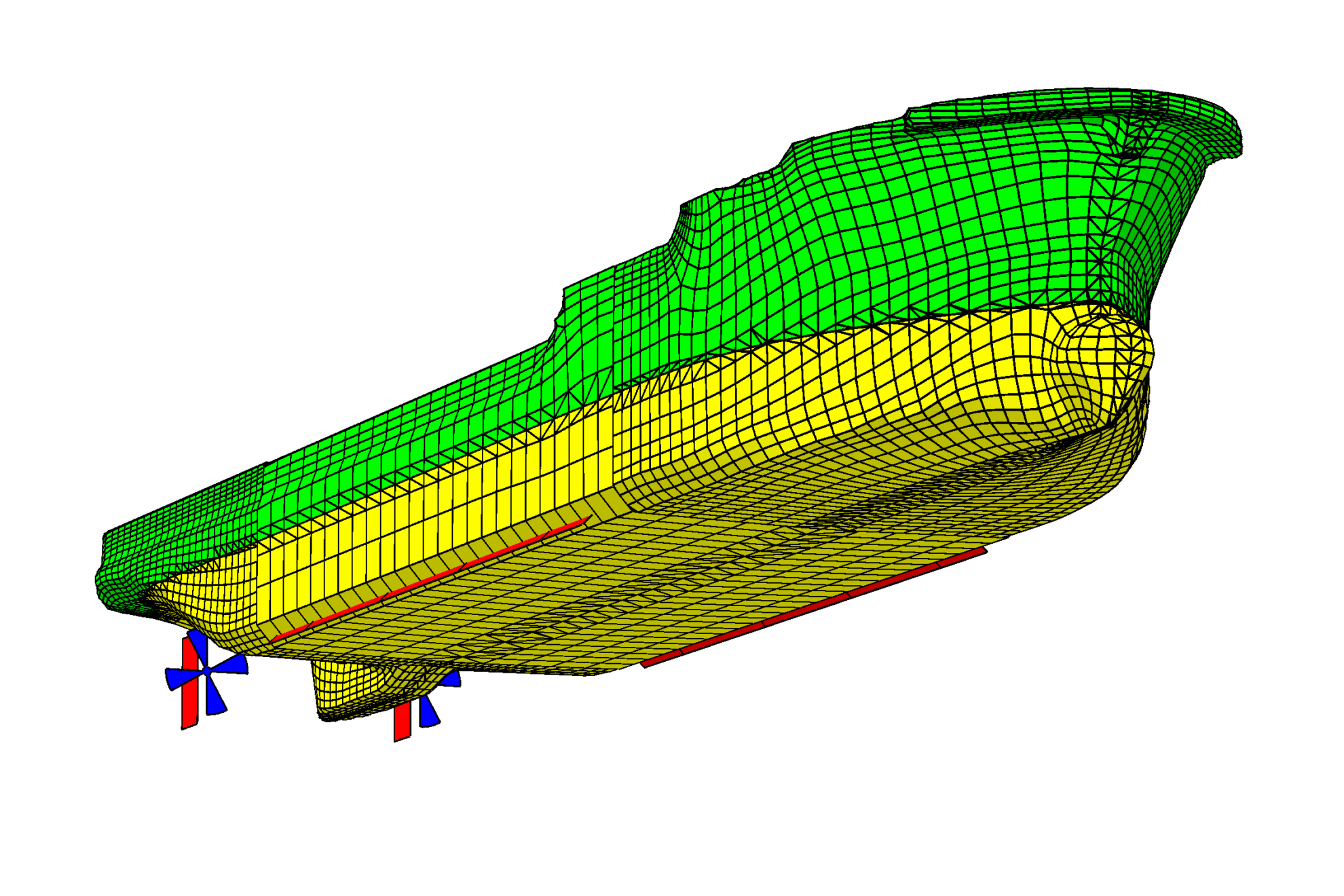
We carry out numerical desktop studies using the ShipMo3D toolset to predict vessel motions in waves. Its underlying seakeeping predictions have been validated against full-scale sea-trial measurements. The zero-speed fin model has been evaluated through comparisons with predictions supplied by fin stabilizer manufacturers.
This provides a practical way to compare stabilization options across a range of sea conditions and vessel speeds, typically at lower cost than physical model tank testing or detailed computational fluid dynamics (CFD) studies.
Where further detail is needed, we can extend the assessment with time-domain simulations in ProteusDS, undertake targeted CFD analysis (e.g. StarCCM+), or liaise with tank-testing facilities on test planning and interpretation of results.
Support for owners, naval architects and shipyards
For vessel owners, we quantify the expected improvement in comfort and operability so it can be weighed against the cost and disruption of a refit.
For naval architects, we check expected motion performance against design objectives and compare configurations to support design decisions and discussions with the owner.
For shipyards, we provide an engineering basis for proposed upgrades, helping customers understand the expected benefit before authorizing work. Realistic expectations and well-supported recommendations help build trust and lasting customer relationships.
For equipment suppliers, we provide vessel-response analysis to support early project discussions and assessment of proposed configurations. We work together to establish suitable modelling inputs and assumptions, with confidentiality arrangements for proprietary information. Supplier expertise informs equipment selection, control-system performance and integration.
Evaluate performance for your vessel
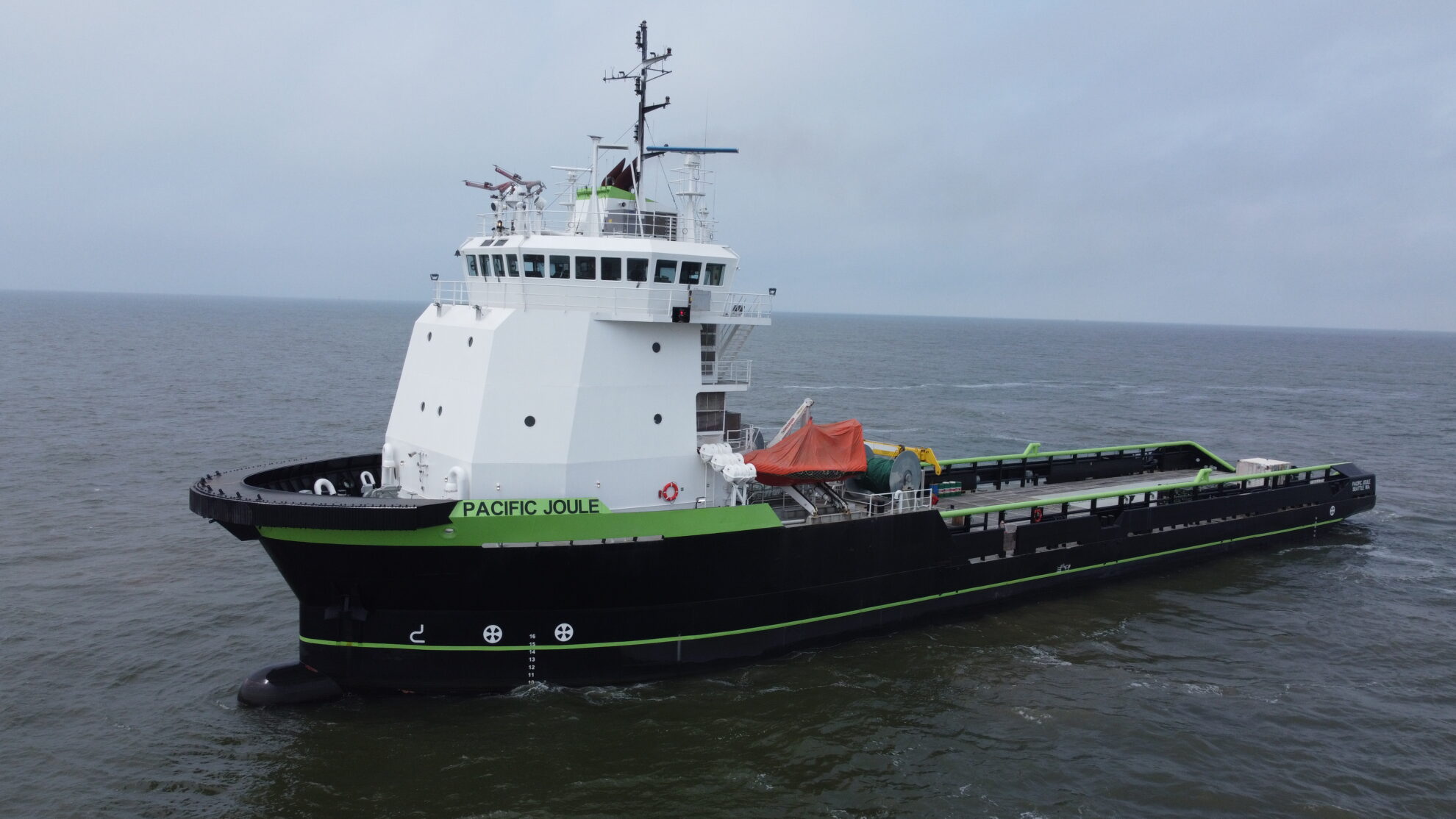
Performance depends on the vessel’s natural motion characteristics, loading condition, speed and sea conditions. We assess the motions and accelerations that matter to your operation, since reducing roll alone may not resolve the issue limiting comfort or operability.
We distinguish performance underway from zero-speed performance. The assessment scope reflects the system’s operating limits and the available performance data, including whether a zero-speed assessment can be supported.
Our assessment approach
- Review hull geometry, loading, appendages and operations; agree sea states, speeds, headings and performance criteria.
- Calculate baseline roll, pitch, heave and relevant accelerations for the vessel’s current configuration.
- Agree system details and limits with your team and stabilization supplier, then compare performance with baseline, accounting for changes to mass, center of gravity and inertia.
- Quantify benefits, adverse effects and uncertainties, and identify where performance objectives are met or further investigation is needed.
Vessel stabilization service deliverables
- Comparisons of roll, pitch, heave and accelerations at selected locations on the vessel
- Predicted changes in motion across sea states, wave headings and vessel speeds
- Assessment against agreed passenger comfort, crew working or equipment operating criteria
- Identification of conditions where system limits reduce the expected benefit
- Comparison plots and tables for candidate configurations
- An engineering report documenting the model, assumptions, limitations and conclusions
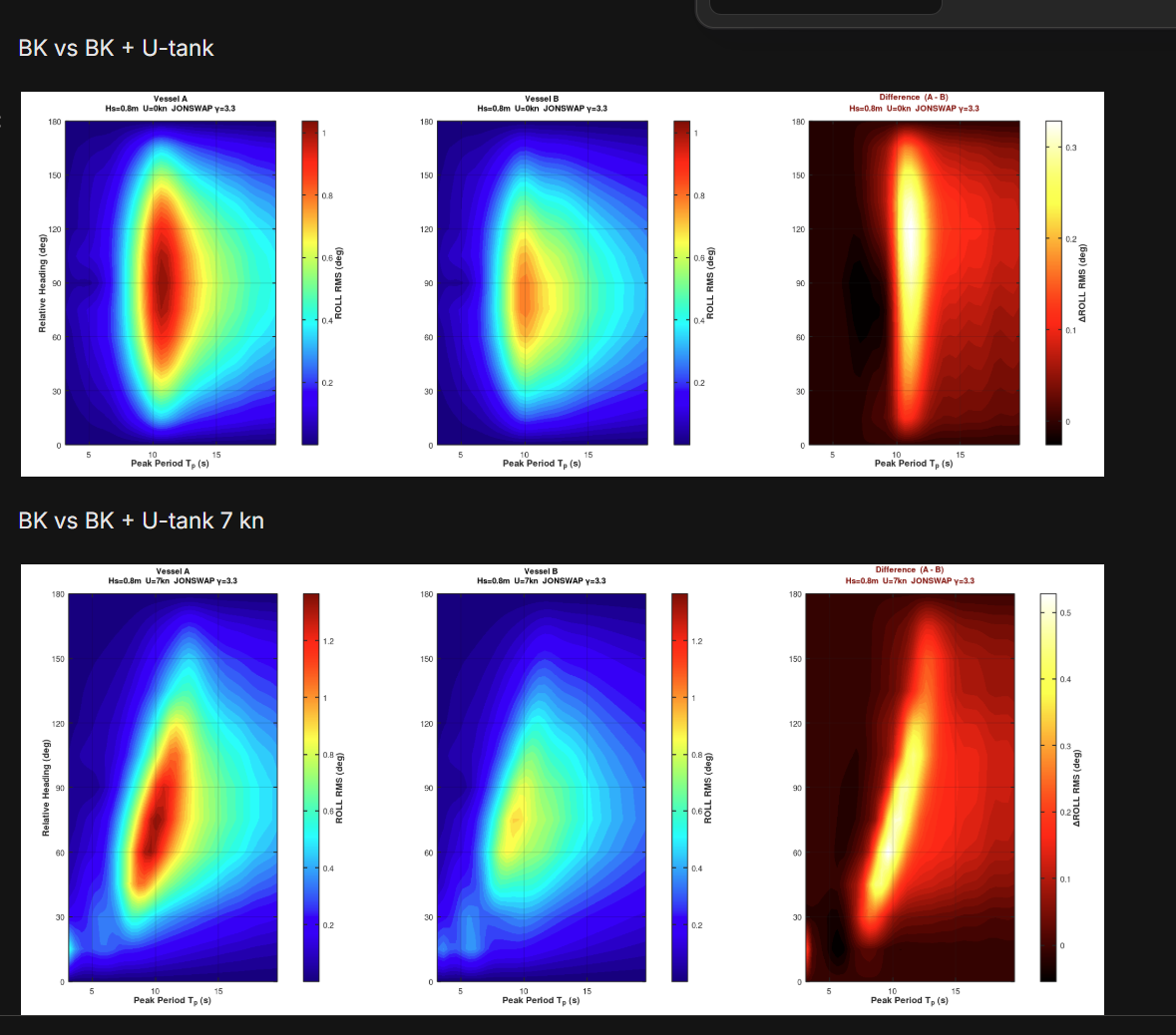
RMS roll predictions from the ShipMo3D toolset within ProteusDS software for a generic offshore supply vessel with bilge keels (left) and with an added U-tube anti-roll tank (centre), at zero speed (top) and 7 knots (bottom). Cooler colours in the vessel-response plots indicate less roll. The right-hand plots show the predicted roll reduction, illustrating how the tank’s benefit varies with wave period and heading.
Our experience
We have 20 years of experience in marine hydrodynamics, including catamaran seakeeping studies and dynamic assessments of ferry and pontoon motions, with predictions of motions and accelerations across operating conditions and comparisons of alternative configurations.
Our in-house software development expertise helps us examine modelling assumptions and investigate specialized requirements, so we can select an appropriate level of analysis for each project.
What we need to get started
Typically, the more information we have the better. We can identify gaps and advise which information is needed for an initial comparison or a more detailed assessment. Typical inputs include:
- Hull lines or a suitable 3D hull model, general arrangement and vessel particulars
- Loading conditions, displacement, centers of gravity and available moments of inertia
- Details of existing appendages and stabilization equipment
- Operating speeds, routes or areas of operation, and relevant sea conditions
- The proposed system’s specifications, installation arrangement, performance data and operating limits
- The motion concern or performance target, plus any available motion measurements or sea-trial results