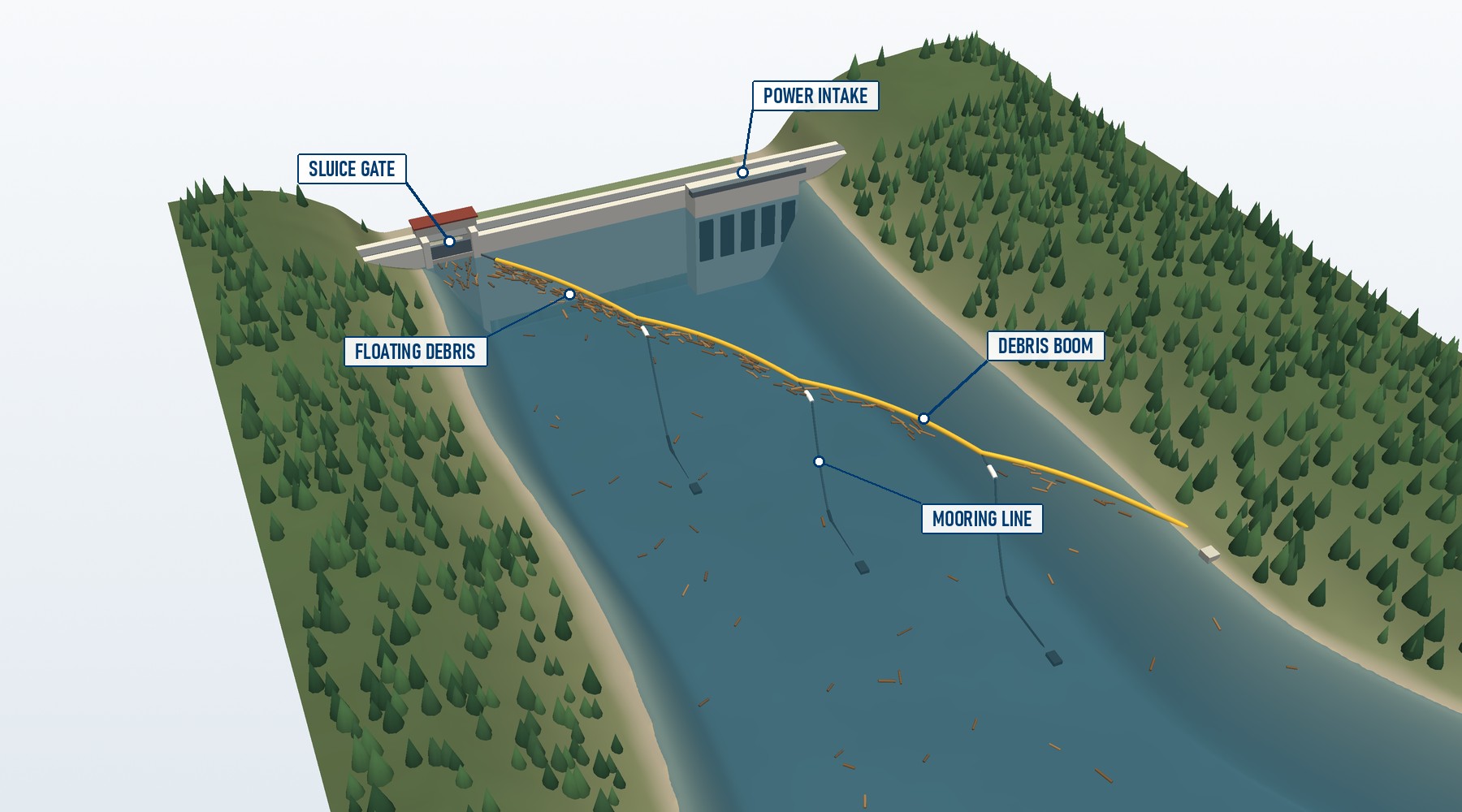
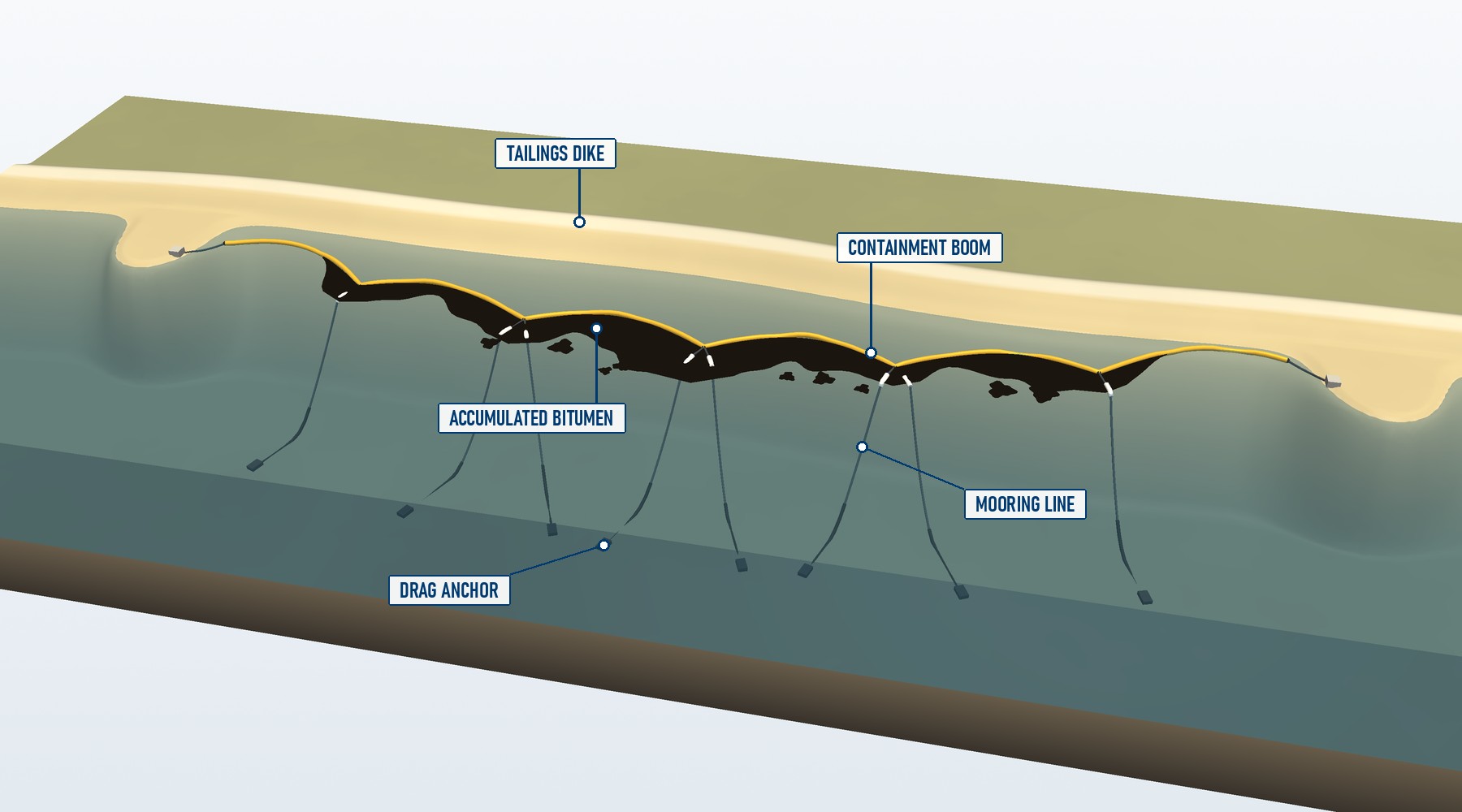
DSA Ocean helps utilities, dam owners, industrial operators, prime engineering firms and boom suppliers assess floating boom systems and design their moorings and anchors. Applications include safety, debris and ice booms, as well as containment booms in tailings and process ponds.
We evaluate how water levels, wind, waves, currents, ice and accumulated material affect buoyancy, freeboard, submergence, connection loads and movement between floating sections, including the effects of attached submerged debris screens.
We also analyze moored floating pipeline systems, including those used in dredging operations, which present similar challenges in buoyancy, bending response, connection loads and mooring design.
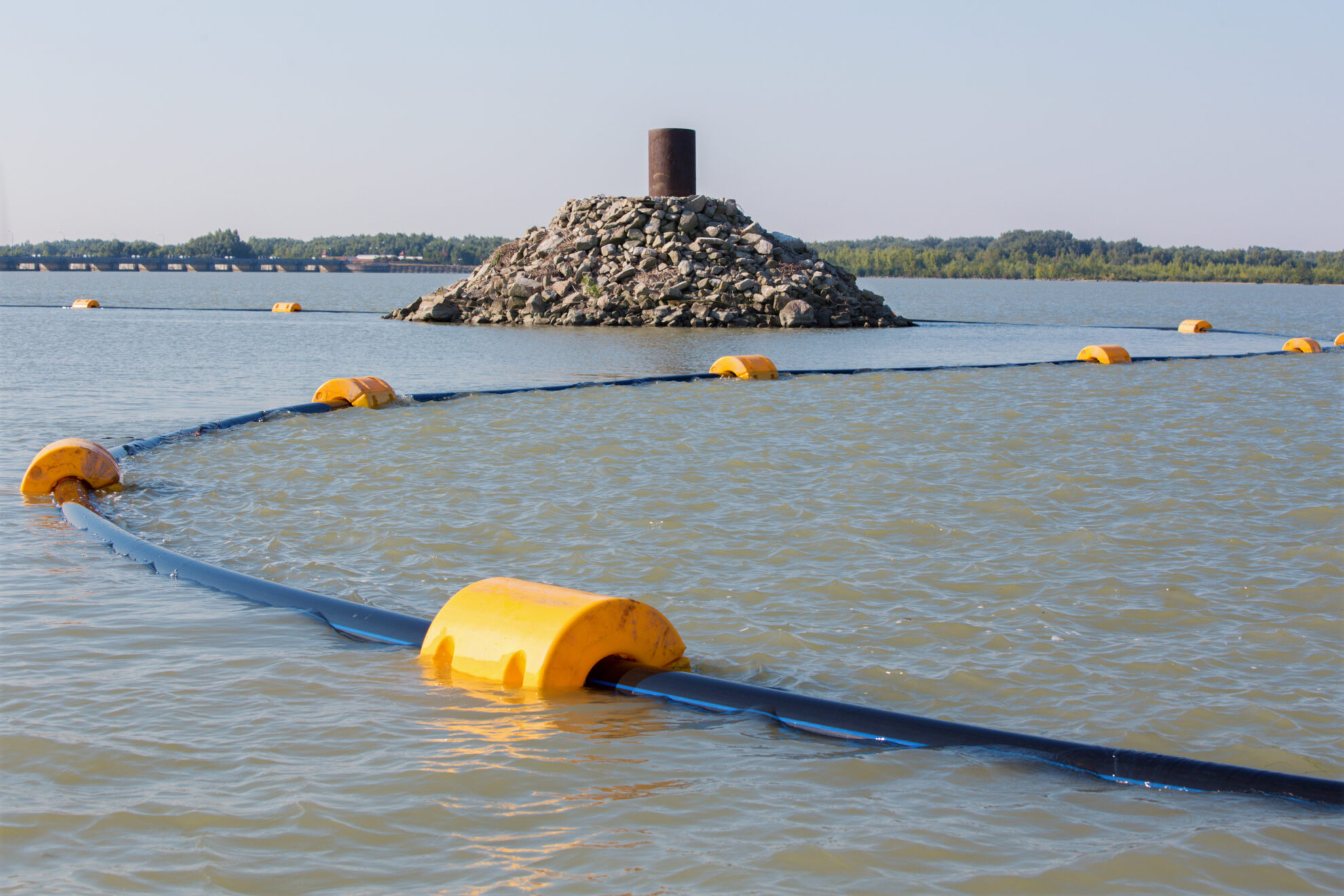
Our analysis helps determine whether a boom and its moorings are suitable for the intended site conditions. The following behaviours guide our selection of loading cases, analysis methods and mooring arrangements.
A boom that performs well at one water level or loading direction may behave differently in another. Design needs to consider the relevant combinations of environmental conditions, water levels and accumulated material, and identify which cases govern the boom, lines, connections and anchors.
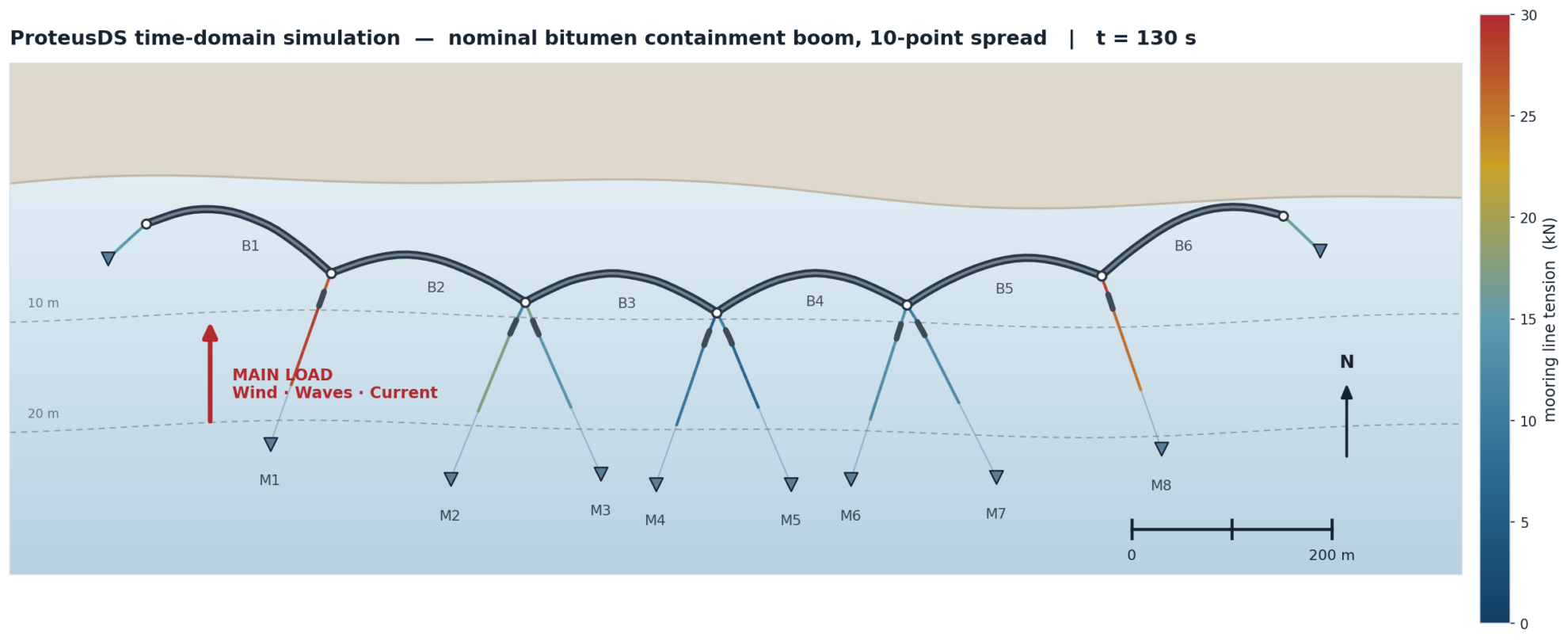
As a boom changes position or orientation, loads redistribute through the floating sections, their connections and the mooring lines. We assess connection loads and relative movement between floating pipe sections, alongside line tensions and anchor reactions. This helps identify where the arrangement needs greater strength, flexibility or movement allowance.
For moorings that rest partly on the seabed or reservoir bottom, chain lifts and settles as the boom moves or water levels change. This changes line geometry, stiffness and the load direction at the anchor. Nonlinear static analysis can capture equilibrium behaviour; dynamic analysis examines the response over time.
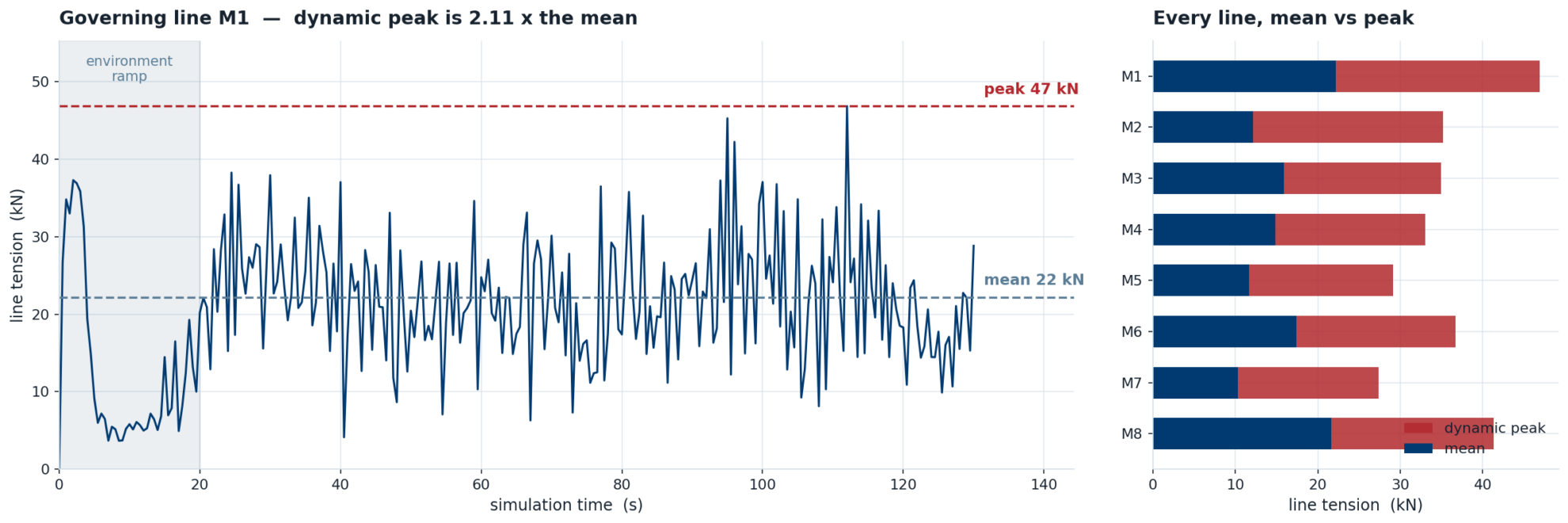
Waves and boom motion can produce short-duration tension peaks above the mean load. Where this affects the design, time-domain analysis helps establish peak line and connection demands. The difference depends on the system and conditions, so it must be evaluated for the site.
Changing water levels alter line geometry, available movement and anchor reactions. Debris, ice or contained material can add loading and change the boom’s response. An attached submerged debris screen also changes the problem: its depth, weight, mesh opening and degree of blockage affect drag, flotation and loads on the screen attachments, boom connections and moorings. We assess these effects together using conditions and accumulation assumptions defined for the site.
Our findings inform mooring arrangements, anchor designs and component requirements for procurement, installation or upgrades. We’ll deliver a turn-key plan. Contact us to discuss your site, selected boom equipment and the decisions you need to make.
Yes. We assess new and existing boom systems and design their moorings and anchors. This can include supplier design reviews, changes in operating conditions, and investigations of excessive movement or failures.
For existing systems, we help identify repair or replacement needs. We can coordinate diver or ROV inspections and use UAV surveys to compare the visible boom arrangement with the design drawings.
We establish relevant combinations of wind, waves, currents and operating water levels using available records, site information and modelling. Where needed, we deploy field equipment to measure environmental conditions.
The assessment considers bathymetry, shoreline geometry, anchor locations and operating constraints, with debris, ice and contained-material loads included where relevant. Loading assumptions and combinations of environmental extremes are documented in the design basis.
We use static analysis for equilibrium loads and configurations, and ProteusDS time-domain analysis where waves or changing loads require it. Dynamic studies use simulation durations and wave realisations appropriate to the design question.
As the developers of ProteusDS, we can investigate the underlying model behaviour and adapt the analysis to the engineering problem. We document the assumptions, governing cases and limitations so the results can be reviewed and used in design.
Depending on the agreed scope, deliverables can include:
For Canadian projects, we can provide reports and mooring drawings signed and sealed by a P.Eng. registered in the project jurisdiction. Certification covers the agreed mooring configuration and design loads, with responsibilities for supplier equipment and supporting structures clearly defined.
For owners, we can establish a common design basis, compare proposals and assess the selected boom system. Customers can retain their preferred supplier and installer.
For prime engineering firms, we provide specialist boom analysis and mooring design as a subconsultant within the wider project team.
For boom suppliers, we provide modelling, connection and screen-load assessment, mooring design and engineering documentation. We coordinate with the supplier and installer on equipment details, installation constraints and maintenance access.
We agree the boom’s intended function, design conditions, load combinations, safety factors and acceptance criteria with the project team. Our mooring work draws on standards and guidance such as ISO 19901-7 and API RP 2SK for stationkeeping analysis, and UFC 4-159-03 for mooring design. We also use relevant methods from the USACE Coastal Engineering Manual for wave and coastal-process assessment. The design basis identifies the editions and provisions appropriate to the system, site and jurisdiction, and explains how they are applied to the boom.
DSA’s scope covers boom performance assessment, including buoyancy, submergence, connection loads and submerged-screen effects, together with mooring design and anchor selection and sizing. The boom manufacturer retains responsibility for detailed product design, including floating sections, connections and screen attachments, using our analysis results as input. Anchor design uses the available ground information, with geotechnical input and installation verification as required. Supporting civil and structural design responsibilities are agreed with the project team. For safety booms, the owner’s public-safety and operating requirements form part of the design basis.
Send us the site location, application and decision you need to make, along with any available layout drawings, floating-section and connection details, screen specifications, operating water levels, bathymetry, environmental records and photographs.
For an existing installation, include inspection reports and any history of movement, damage or maintenance problems. We can start with the information you have and identify the additional inputs needed.